Saturday, April 9, 2011

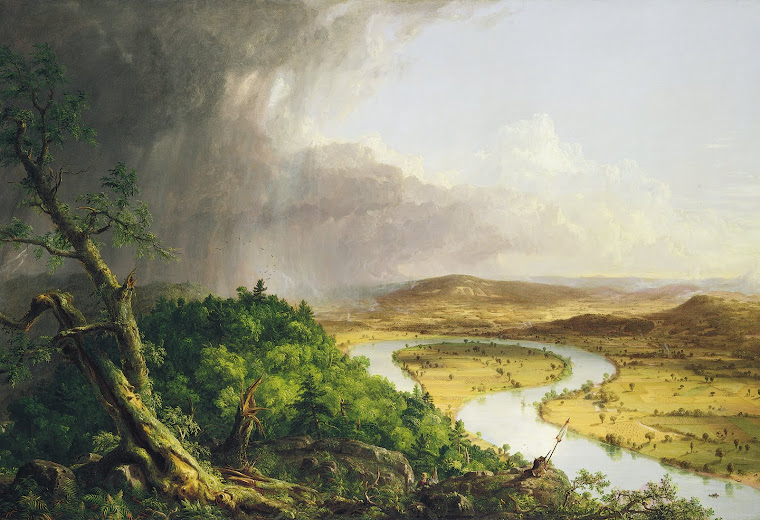
Hawthorne, Blithedale Romance, Day #1

--As we've come to the 'synthesis' or city/country section of the course, a number of the issues that interest me about this text reflect on things we've already studied, so...

--Compare Coverdale's attitude toward the transformative possibilities of country living and agrarian labor with that of Thoreau in Walden.

--In much of the city writing we examined, the notion of the city as a place of watching, spying or being a voyeur is explored. How does this novel thematize or explore this in the utopian community? What is Coverdale's explanation, justification or qualification of his own tendency to pry into the private matters of others?

Tuesday, April 5, 2011

Webb, The Garies and their Friends, Day #3

--This section focuses primarily on the drama of Clarence's passing. How are we to view Clarence and his passing? It is often figured as or likened to a criminal act (Walters compares it to forgery), but Clarence is also seen as a victim: what is the novel's attitude toward passing?

--Clarence's sister, Emily, is clearly meant as an alternative to passing. What do her choices and the novel's vision of her say about mixed race characters and their place in the African-American community?

--The novel ends with a celebration. How does it depict African-American community and its relationship to the larger white community?

Wednesday, March 30, 2011

Webb, Garies & Their Friends, Day #2

--In light of our conversation in class before break about racial distinctions and the shifting categories of blackness in the novel, how does this reading add to or further complicate racial categories through characters like Mr. Walters or the experiences of Mr. Stevens when he tries to hide his identity through a new set of clothing (which begins a whole series of racial transformations for him)?

--In this section of the novel, we are led through the process whereby a race riot is started. What does this tell us about the novel's vision of the origin and/or process of racism in antebellum America? How would you compare this vision of racism to contemporary notions of or attitudes toward racial conflict?

--In this section, Mr. Walters comes to stand out as a representative figure of blackness. What does he represent and how are his politics embodied in his actions during the riot? What do you see as Webb's broader message to a black or white audience through Walters?

Tuesday, March 22, 2011

Webb, The Garies and their Friends, Day #1

--Webb's novel touches on a couple of unusual topics of early African-American fiction: mixed-races couples and urban life.

--How does the novel address racial mixing, mixed-race couples and the possibility of "passing" (the practice of a African-American person passing for white)?

--How does it imagine the life of African-Americans in northern cities? Compare the vision of city life to the many we have studied previously.

Saturday, March 19, 2011

Melville, "Bartleby, the Scrivener"


--No, watching the Crispin Glover starring version of the movie won't help you much for class discussion, but it suggests contemporary relevance.

--What sort of image of the city is offered here? Compare to the depictions of the city offered by the other authors we've read in this section of the term.

--"Bartleby" is a story of the city and represents, to a certain extent, the attempt of a person of the upper middle class (the lawyer) to understand and 'help' a person of the lower class (Bartleby). Compare the lawyer and his thinking about Bartleby to the thinking others we've read (Child, Fuller, Boucicoult, Poe) have given to the problem of understanding the "other" (mostly poor) in the city.

--This is also a story about management, that immaterial labor of making sure that others work productively and happily that has come to define middle class experience (if you don't make or sell something, you make sure that others make or sell something). Consider what the story has to say about management. Compare it to working experiences you've had either as a manager or being managed and to contemporary depictions/satires of this work dynamic ("The Office" comes to mind, but others as well).

Tuesday, March 15, 2011

Boucicoult, "the Poor of New York

--This is an image from another of Boucicoult's melodramatic plays, The Octoroon, but conveys the kind of staging that would take place for one of these plays.

--Written and set during the Panic of 1857, a major economic downturn brought on significantly by financial speculation, "The Poor of New York" certainly has resonances with our contemporary situation, especially in attitudes toward bankers and finance. What specifically is the critique of banking offered here and what set of values oppose it?

--Though it is called "The Poor of New York," the social politics of the play seem complicated. How is poverty examined here? What does the play have to say about distinctions between rich and poor? Compare its politics and final call to action to the urban reformist texts of Child and Fuller: how are they similar or different?

--This play is described as a melodrama and while we will hear more about this means in class, it is safe to say that melodrama depends upon relatively simple moral distinctions between good and evil and a kind of hyperbolically emotional style. How do you respond to this as a reader? Do you think such a mode is still present in our culture and, if so, where? What are the pleasures and/or pains of melodrama for you?

Sunday, March 13, 2011

Poe, "The Murder of Marie Roget"

--This image comes from a contemporary depiction of Mary Rogers, the New York City 'cigar girl' whose story is vaguely fictionalized for Poe's tale.

--Some of the plot hinges upon conflicting notions about city life. The fact that Marie is not recognized by anyone in the city seems to be a point of contention between different theories about her disappearance. How do these differences fit with discussions we've seen so far about the city as an anonymous, alienated space versus a space of social connection?

--This is in many ways a very strange story--based in fact, but offered up as fiction; making claims about truth and probabilities. How does it fit or not fit with expectations one has about the detective story genre (itself in formation at this very moment)? How do we fit this story with or compare it to the popularity in our own period of fact-based crime dramas, 'true-crime' fictions or even 'non-fiction novels' (like Capote's In Cold Blood)?

--How do we compare Dupin, the detective who refuses to leave his house but 'solves' the crime (or at least proposes ways to solve the crime), to other city narrators we've read who imaginatively engage with life in the city (whether the narrator of "The Man of the Crowd," "Wakefield," or Child)?